


Semiconductor Optical Amplifiers (SOA): Principles, Applications, and High-Power Technology Analysis
Time:2026-03-18
Views:156
Semiconductor Optical Amplifiers (SOA): Principles, Applications, and High-Power Technology Analysis
In cutting-edge optoelectronic fields such as optical communications, lidar and photonic integration, semiconductor optical amplifiers (SOA) are the core device for optical signal enhancement. They have the advantages of small size, low cost, easy integration, and fast response speed. They are gradually replacing traditional optical amplification solutions and becoming a key component supporting the development of high-speed optical networks and high-power optical systems. This article will analyze the working principle and full-scenario application of SOA in detail, focusing on the technical characteristics, design challenges and application value of high-power SOA, which will help to fully understand the core advantages of this "optical signal booster". The core working principle of SOA The operation of SOA is essentially based on the stimulated emission effect of semiconductor materials. Their core principle is similar to that of semiconductor lasers, but they eliminate the resonant cavity of the laser and only achieve one-way amplification of the optical signal without converting it into an electrical signal, thus avoiding losses and delays caused by photoelectric conversion. The core structure of SOA consists of the active area (using a multi-quantum well structure), waveguides, electrodes, drive circuits and input/output interfaces. As the core component of optical amplification, the active area usually uses semiconductor materials such as InGaAsP/InP to achieve optical signal enhancement through carrier transition.
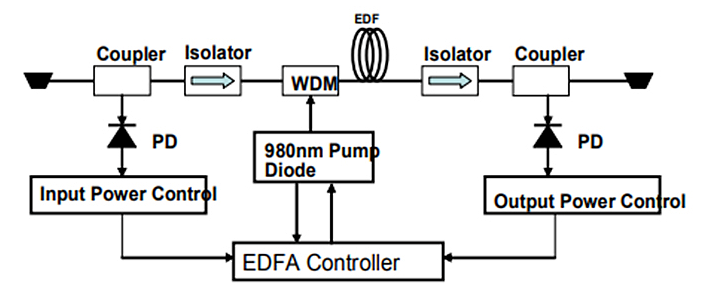
The specific working process can be divided into four key steps: first, pump injection. A forward bias current is injected into the active region, exciting charge carriers (electrons) in the semiconductor material from the valence band to the conduction band, creating a "number inversion" state - meaning that the number of electrons in the conduction band is much greater than the number in the valence band. Second, stimulated radiation. When a weak input light signal (photon) enters the active region, it collides with a higher energy level electron, causing the electron to transition back to the valence band and release a new photon with the same frequency, phase, and polarization direction as the incident photon. Third, the optical signal is enhanced. A large number of electrons release photons through stimulated emission, and the stimulated emission and incident photons are superimposed to achieve exponential amplification of the optical signal power, usually achieving an optical gain of more than 30dB (1000 times). Fourth, signal output. The amplified optical signal is transmitted to the output port through the waveguide to complete the entire amplification process. At the same time, electrons that do not participate in stimulated emission release energy through non-radiative recombination, requiring a thermal management system to dissipate heat and ensure stable operation of the equipment.
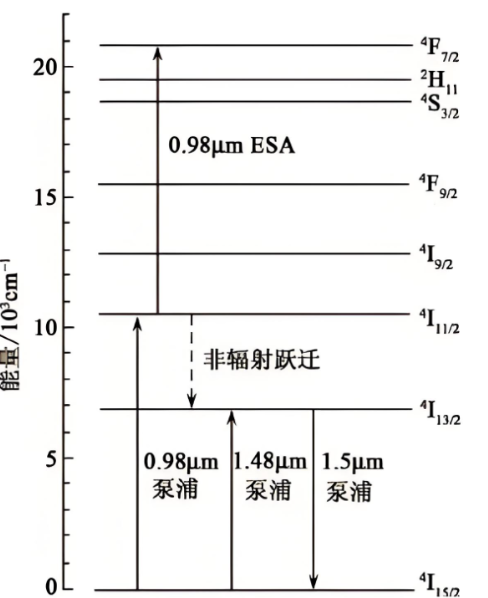
It is worth noting that SOA has certain limitations, including polarization dependence, high noise (amplified spontaneous emission, ASE noise) and temperature sensitivity. In recent years, through structural designs such as strained quantum wells and hybrid quantum wells, its gain flatness and stability have been significantly optimized, expanding its application range. According to the design of the resonant cavity, SOA is mainly divided into traveling wave optical amplifier (TWLA), Fabry-Perot semiconductor laser amplifier (FPA) and injection locked amplifier (IL SOA). Among them, the traveling wave type, whose end surface is coated with anti-reflection (AR) film, has the characteristics of wideband, high output and low noise, making it the most widely used type at present. 2. Application Scenarios of SOA in Various Fields SOA has been used in many fields such as optical communications, laser radar, optical fiber sensing, and biomedicine due to its advantages such as small size, wide bandwidth, high gain, and fast response speed (nanosecond level), and has become an indispensable core device in optoelectronic systems. Their application scenarios can be divided into four major categories:
In the field of optical communications, SOA, as the core gain unit, is mainly used to compensate for losses during optical signal transmission. In long-distance fiber optic communications, they can be used as repeater amplifiers to extend signal transmission distances. In data center interconnection (DCI) systems, they can be integrated into 400G/800G optical modules to increase the link optical power margin and extend the transmission distance from 40km to 80km. In 10G/40G/100G transmission systems and coarse wavelength division multiplexing (CWDM) systems, they solve the problem of amplifying O-band (1260-1360nm) optical signals, reduce single-port costs, and support multiple working modes such as ACC, APC and AGC to meet the needs of different scenarios.
In the field of lidar, SOA acts as a power amplifier, which can significantly increase the output power of the laser source to meet the requirements of long-distance detection. In automotive lidar, 1550nm SOA can enhance the emitted optical power of narrow linewidth lasers and support long-range detection of L4 autonomous driving. In scenarios such as drone mapping and security monitoring, they can generate high-extinction ratio pulses to improve detection accuracy and range. In the field of optical fiber sensing, SOA can amplify weak sensing light signals, improve the system signal-to-noise ratio, and extend the detection distance. In distributed sensing systems, such as bridge strain monitoring and oil and gas pipeline leakage detection, they replace acousto-optic modulators to generate narrow pulses to achieve accurate monitoring. In environmental monitoring, they can enhance the stability of optical sensing signals and improve monitoring sensitivity.
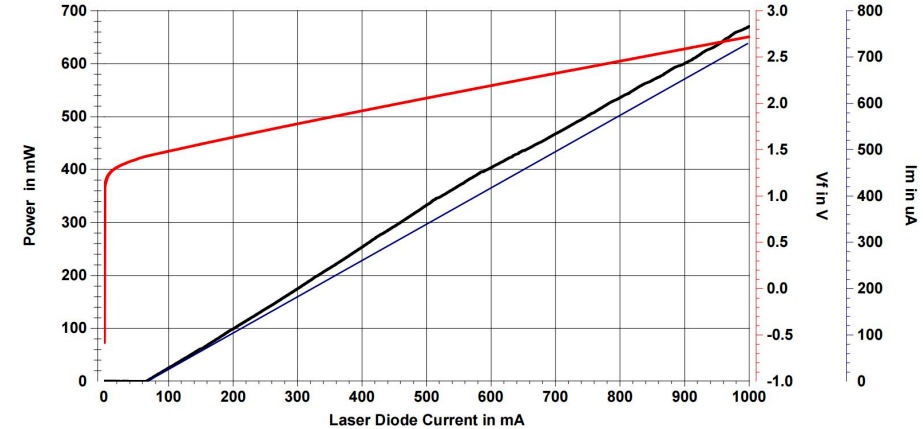
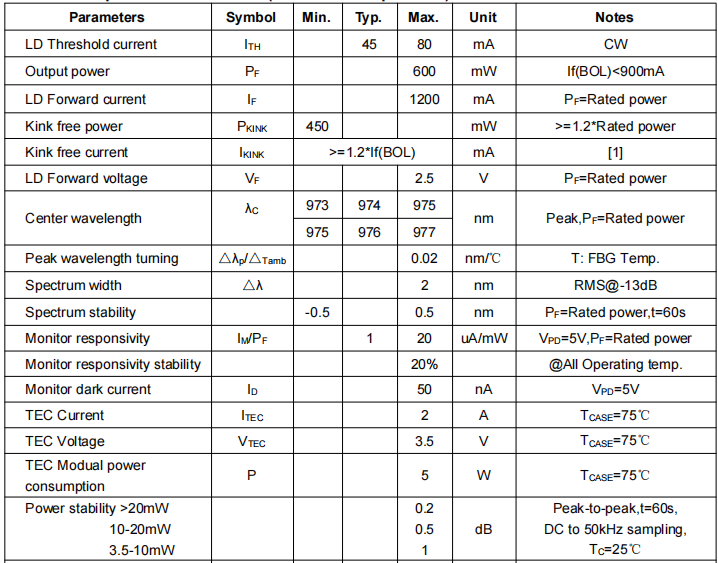
Furthermore, SOA shows great potential in biomedical and optical computing. In ophthalmic and cardiac OCT imaging devices, integrating SOA with specific wavelengths can improve detection sensitivity and resolution. In optical computing, their fast nonlinear effects provide the physical basis for core units such as all-optical logic gates and high-speed optical switches, promoting the development of all-optical computing technology.


 mail
mail 19129454176
 QQ
QQ