


Polarization of Laser Radiation
In most cases the emitted light from the laser is polarized. Usually linearly polarized, that is, the electric field oscillates in a specific direction perpendicular to the direction of propagation of the laser beam. Some lasers (eg, fiber lasers) do not produce linearly polarized light, but other stable polarization states, which can be converted to linearly polarized light using a suitable combination of waveplates. In the case of broadband radiation, and the polarization state is wavelength dependent, the above method cannot be used.
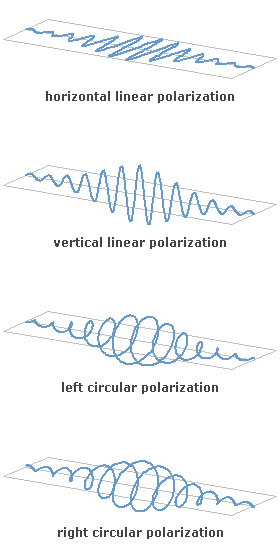
Figure 1: Laser radiation with different polarization states, with several pulses propagating from left to right.
In some special cases, radially polarized beams can be generated, ie the polarization direction in the beam cross-section is radial. Generally, radially polarized radiation is obtained by first polarizing light through some optical elements, or it can be obtained directly from a laser. The advantage of this method is that depolarization losses can be avoided, and it can be applied to solid-state bulk lasers.
Polarized laser radiation is required in many applications. E.g:
Nonlinear frequency conversion, where phase matching can be satisfied in only one polarization direction
Two laser beams are required for polarization coupling (see polarization beam combining)
Processing laser beams in polarization-dependent devices such as interferometers, semiconductor optical amplifiers and optical modulators
There are also some lasers (many fiber lasers) that emit light that is not polarized. This does not mean that the output of the laser is unpolarized light. The powers of the two polarization components are equal at any time, and the amplitudes of the two are completely independent. It‘s just that the polarization state is very unstable, for example, due to temperature fluctuations, or changes between different directions. In order to obtain completely unpolarized light, some depolarization optics are required.
The degree of polarization of linearly polarized light is characterized by the polarization extinction ratio (PER), which is defined as the ratio of the power in the two polarization directions, in decibels. The extinction ratio of the polarizer must be greater than that of the laser beam.


 mail
mail 19129454176
 QQ
QQ