


Polarization-maintaining fiber
Time:2025-03-03
Views:241
In various optical fiber interference instruments, in order to obtain the maximum coherence efficiency, the polarization state of the optical fiber propagating light is required to be very stable. The transmission of light in a single-mode fiber is actually two orthogonal polarization fundamental modes. When the optical fiber is an ideal optical fiber, the transmitted fundamental mode is two orthogonal double degenerate states, and the actual optical fiber is drawn due to There will be unavoidable defects, which will destroy the double degenerate state and cause the polarization state of the transmitted light to change, and this effect will become more and more obvious as the length of the fiber grows. At this time, the best way is to use Polarization maintaining fiber.
Polarization maintaining fiber is to maintain the polarization state of the fundamental mode in the fiber. The most common method is to artificially introduce a large birefringence into the fiber, so that the propagation constants of the two fundamental modes are very different, so that the two fundamental modes are not easy to occur. Coupling to achieve polarization maintaining.
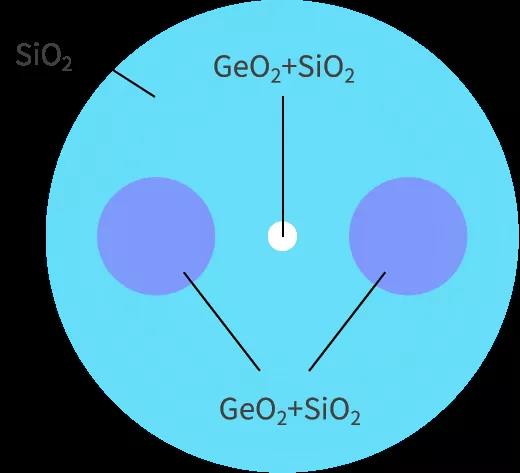
Currently the most widely used is the "Panda" type polarization maintaining fiber, which is a high birefringence fiber structure dominated by stress birefringence. The linear stress of the boron-doped layer is converted into a refractive index difference through the photoelastic effect, which causes a high Birefringence.
Polarization-maintaining fiber has two main transmission axes, called the fast axis and the slow axis of the fiber. The fast axis has a small refractive index and fast light transmission speed, and the slow axis has a large refractive index and slow light transmission speed. Accurate measurement of the time delay difference between the fast and slow axes is very meaningful for the evaluation of fiber preparation, optical device manufacturing and optical communication links. The use of optical frequency domain reflectometry (OFDR) and optical vector analyzer can achieve high-precision (±0.1ps) measurement of polarization maintaining The delay difference between the fast and slow axis of the optical fiber.
Polarization maintaining fiber is to maintain the polarization state of the fundamental mode in the fiber. The most common method is to artificially introduce a large birefringence into the fiber, so that the propagation constants of the two fundamental modes are very different, so that the two fundamental modes are not easy to occur. Coupling to achieve polarization maintaining.
Currently the most widely used is the "Panda" type polarization maintaining fiber, which is a high birefringence fiber structure dominated by stress birefringence. The linear stress of the boron-doped layer is converted into a refractive index difference through the photoelastic effect, which causes a high Birefringence.
Polarization-maintaining fiber has two main transmission axes, called the fast axis and the slow axis of the fiber. The fast axis has a small refractive index and fast light transmission speed, and the slow axis has a large refractive index and slow light transmission speed. Accurate measurement of the time delay difference between the fast and slow axes is very meaningful for the evaluation of fiber preparation, optical device manufacturing and optical communication links. The use of optical frequency domain reflectometry (OFDR) and optical vector analyzer can achieve high-precision (±0.1ps) measurement of polarization maintaining The delay difference between the fast and slow axis of the optical fiber.


 mail
mail 19129454176
 QQ
QQ